TL;DR
- Private-label uses pre-formulated products for faster launches; contract manufacturing builds custom formulas from scratch — choose based on budget, timeline, and differentiation goals.
- Top US manufacturers are selected for FDA/MoCRA compliance, GMP and ISO 22716 certifications, flexible MOQs, and proven category expertise.
- This list profiles five US-based facilities for 2026, evaluated on regulatory standing, formulation depth, client fit, and market reputation.
- Each manufacturer below suits a different brand stage — from first SKU to retail-scale distribution.
Overview of Private-Label Cosmetics Manufacturing in the USA
Private-label cosmetics manufacturing uses pre-developed formulas that brands rebrand under their own name for faster launches, while contract manufacturing (OEM) develops custom formulations built to your exact specifications. Private label suits brands prioritizing speed and lower upfront costs; contract manufacturing fits those needing unique formulations and proprietary ingredients.
The US market offers a distinct regulatory advantage following the Modernization of Cosmetics Regulation Act of 2022 (MoCRA), which took effect December 29, 2023. MoCRA significantly expanded FDA authority over cosmetics, requiring facility registration, product listing, safety substantiation, and adverse event reporting within 15 business days. These requirements apply to domestic and overseas manufacturers exporting to the US, making US-based partners compliant by design and audit-ready.
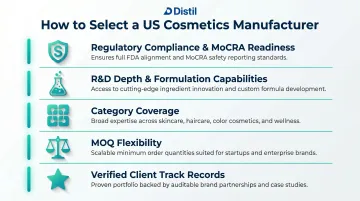
That compliance baseline shaped the selection criteria for this guide. Each manufacturer profiled below was evaluated across:
- Regulatory compliance and MoCRA readiness
- R&D depth and formulation capabilities
- Category coverage and MOQ flexibility
- Verified track records serving brands from DTC startups to retail-ready operations
Top Private-Label Cosmetics Manufacturers in the USA (2026)
Selection criteria included FDA/MoCRA compliance, formulation capability, product category breadth, MOQ accessibility, and publicly verifiable client track records. Each manufacturer below meets these benchmarks while serving distinct brand stages and product needs.
Kolmar Laboratories (Pennsylvania)
Kolmar USA has operated from its Life Science Drive campus in Olyphant, Pennsylvania since 1993 — one of the longest-running cosmetic contract manufacturers in the country. It serves major beauty brands across skincare, color cosmetics, and OTC products, with production infrastructure scaled for both mass-market and prestige lines.
Key differentiators:
- Advanced reverse engineering and custom formulation services
- High-volume production infrastructure for enterprise-scale brands
- Strong regulatory systems with regular FDA inspection protocols
- Extensive formula library with full turnkey launch support
| Product Categories | Skincare, color cosmetics (lipstick, foundation, powder), OTC products, personal care |
|---|---|
| Certifications / Compliance | FDA Registration #1000221288 (OTC & cosmetics), ISO 22716:2007 (cosmetics GMP), cGMP compliant per 21 CFR Part 211 |
| Ideal For | Mid-market to enterprise brands needing large-scale, technically complex formulations |
Cosmetic Solutions (Florida)
Cosmetic Solutions operates from a 100,000-square-foot Innovation Campus in Boca Raton where formulation, testing, manufacturing, and fulfillment happen under one roof. Over 30 years of operation, the company has built a reputation for science-driven skincare and a private-label catalog that cuts time-to-market.
Key differentiators:
- Clinical-grade active ingredient integration for performance skincare
- In-house R&D lab with vertically integrated testing and validation
- 500+ private-label SKUs enabling fast product launches without custom development
- End-to-end filling and packaging for brands at any production volume
| Product Categories | Skincare serums, cleansers, moisturizers, anti-aging treatments, topical wellness products |
|---|---|
| Certifications / Compliance | FDA Registered, cGMP Compliant, ISO 22716 Certified |
| Ideal For | Skincare brands prioritizing science-backed formulations or fast launches via private label |
Dynamic Blending (Utah)
Dynamic Blending is based in Vineyard, Utah and is a common first choice for emerging brands — primarily because of its low MOQs and willingness to support brands through early-stage product development across skincare, personal care, body care, and wellness categories.
Key differentiators:
- Lower minimum order quantities accessible to startups and indie brands
- In-house branding and packaging design services for turnkey launches
- Custom formulation across multiple categories with USDA Organic and NSF Organic certifications
- Dedicated startup assistance and guidance through early growth stages
| Product Categories | Skincare, personal care, body care, topical wellness products, powders |
|---|---|
| Certifications / Compliance | FDA Registered Facility, ISO 22716:2007 (cosmetics GMP), ISO 9001:2015 (quality management), NSF Organic, USDA Organic |
| Ideal For | Startups and indie brands needing low MOQs, category flexibility, and integrated branding support |
Nutrix Manufacturing (Utah)
Nutrix Manufacturing is a Salt Lake City-based GMP-certified contract manufacturer. Its 8–14 week turnaround, clean batch documentation, and audit-ready processes make it a practical choice for brands where compliance consistency directly affects retail or distributor relationships.
Key differentiators:
- FDA-registered facility with NSF ISO and HACCP certifications
- Emphasis on audit-ready documentation and batch consistency
- Competitive pricing relative to quality tier
- Flexible program structure covering private-label, custom formulation, and wholesale
| Product Categories | Skincare (creams, serums, moisturizers), hair care, body care, oral care, cosmetics |
|---|---|
| Certifications / Compliance | FDA Registered Facility, NSF ISO Certified, HACCP Certification |
| Ideal For | Brands scaling from initial launch who need reliable batch consistency and strong compliance infrastructure |
Lady Burd Cosmetics (New York)
Lady Burd has operated out of Farmingdale, New York since 1972. The family-owned company offers a pre-developed formula library, customizable packaging, and MOQs as low as $150 for stock items and 12 pieces per shade for private label — one of the lowest barriers to entry in the US market.
Key differentiators:
- Extensive ready-made formula catalog that accelerates brand launch
- Industry-low MOQs with full-color custom label support
- Experienced team with 50+ years of heritage in makeup and skincare
- Clean and vegan formulation options available
| Product Categories | Makeup (lipstick, foundation, eyeshadow), skincare, personal care products |
|---|---|
| Certifications / Compliance | FDA-registered US manufacturer; third-party certifications not publicly disclosed |
| Ideal For | New and emerging brands wanting a curated formula catalog with flexible branding and low barrier to entry |
How We Chose These Manufacturers
Manufacturers were evaluated across five criteria: FDA/MoCRA compliance and facility certification status, in-house formulation and R&D depth, product category coverage, MOQ accessibility relative to brand stage, and publicly verifiable track records with beauty brand clients.
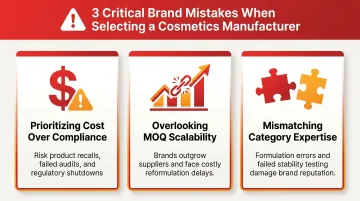
These criteria exist because brand selection errors are common — and costly. Watch out for these missteps when evaluating manufacturers:
- Prioritizing low cost over compliance standards, which creates regulatory risk down the line
- Overlooking MOQ scalability, so the relationship breaks down as volume grows
- Mismatching category expertise — a facility excelling in powder compacts may lack emulsion stability testing protocols critical for serums
Brands that want to refine their ingredient systems before committing to a full-scale US manufacturer can benefit from an upstream R&D partner. Distil is an ingredient and formulation platform that works with personal care brands at this pre-production stage. Its offering includes:
- Custom formulations: high-purity cosmetic esters, zinc oxide UV filters, and sugar-based surfactants
- Sustainable sourcing with RSPO-certified feedstocks
- IP-protected development from lab to commercial scale
With R&D facilities in India and a North America office in New Jersey, Distil helps brands lock in formulation specs before handing off to a contract manufacturer.
Conclusion
Choosing a private-label cosmetics manufacturer means choosing a compliance partner, formulation resource, and scalability enabler — not just a production vendor. Selecting based on price or brand recognition alone often leads to reformulation costs, regulatory delays, and quality failures that are expensive to unwind.
Before committing to a production run, work through this checklist:
- Narrow your shortlist to 2-3 manufacturers and request samples or pilot batches
- Verify certifications directly with FDA and ISO registries — don't rely on self-reported claims
- Align on documentation expectations upfront (CoA formats, batch records, label compliance)
- Ask specifically how they handle MoCRA adverse event reporting
- Confirm batch release testing protocols and turnaround timelines
- Clarify whether MOQs can scale as your brand grows
Brands working on formulation inputs before approaching a manufacturer can reach out to Distil's personal care team. Distil supplies cosmetic ingredients — including UV filters, emollients, mild surfactants, and aroma chemicals — with application-specific R&D, sustainable sourcing, and IP protection built into the process. Getting your ingredient specifications locked in early reduces reformulation risk once you're in production. Contact Distil at contact@distil.market or through their New Jersey office.
Frequently Asked Questions
What is the difference between private label and contract manufacturing in cosmetics?
Private label uses pre-developed formulas that you rebrand under your own name for faster launch (typically 6-8 weeks), while contract manufacturing (OEM) involves developing a custom formulation built to your specification, which can take 6-12 months. The right model depends on your budget, timeline, and how differentiated your product needs to be.
What certifications should a US private-label cosmetics manufacturer have?
Look for FDA registration, CGMP compliance, and ISO 22716 (the international cosmetics GMP standard). Post-MoCRA, also confirm the facility maintains product listing, safety substantiation records, and adverse event reporting protocols, as these directly affect retail eligibility and audit readiness.
What is a typical minimum order quantity (MOQ) for US private-label cosmetics manufacturers?
MOQs vary widely—from as low as a few hundred units at boutique manufacturers like Lady Burd (12 pieces per shade) to tens of thousands at large-scale facilities. Private-label programs typically range from 100-500 units, while custom formulations often start at 6,000+ units. Match MOQ expectations to your current stage rather than over-committing on volume early.
How long does it typically take to launch a private-label cosmetics line in the USA?
Timelines range from 6-8 weeks for turnkey private-label programs using existing formulas to 6-12 months for fully custom formulations. Regulatory review, packaging development, stability testing, and ingredient sourcing all add to lead time.
Are US-based private-label manufacturers more expensive than overseas alternatives?
Yes, US manufacturers typically carry a higher cost base than Asian or Eastern European alternatives. However, they offer offsetting advantages in compliance certainty, communication quality, faster turnaround, and lower regulatory risk, which matters most given MoCRA's facility registration and adverse event reporting requirements. Domestic production also avoids import tariffs, customs delays, and IP exposure risks.
What is MoCRA and why does it matter for private-label cosmetics brands?
MoCRA (Modernization of Cosmetics Regulation Act, enacted 2022 and effective December 2023) significantly updated FDA authority over cosmetics, requiring facility registration, product listing, safety substantiation, and adverse event reporting within 15 business days. Working with a US manufacturer already operating under MoCRA compliance reduces regulatory exposure, simplifies audits, and ensures your products meet federal safety requirements from day one.