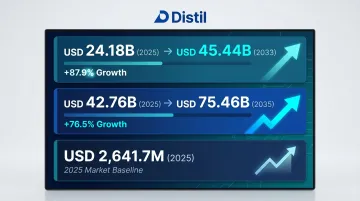
According to Grand View Research, the global personal care contract manufacturing market reached USD 24.18 billion in 2025 and is projected to hit USD 45.44 billion by 2033. Meanwhile, IndustryResearch.biz reports that approximately 70% of beauty and personal care brands now outsource production to focus on formulation and branding. This surge reflects a broader shift: brands want to control their formulas and market positioning while offloading the complexity and capital burden of manufacturing infrastructure.
TL;DR
- Toll manufacturing = client supplies raw materials; manufacturer provides equipment, labor, and processing expertise for a flat fee
- Contract manufacturing = manufacturer handles sourcing, formulation, and delivery under a single agreement
- Key decision factor: control over raw materials and formula versus full operational offloading
- Toll manufacturing suits companies with established supplier relationships; contract manufacturing suits those prioritizing speed-to-market
- IP protection requires different safeguards in each model — structured agreements are non-negotiable
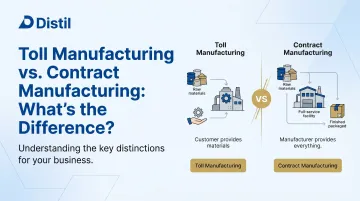
Toll Manufacturing vs. Contract Manufacturing: Quick Comparison
The five dimensions below capture where the two models diverge most sharply for chemical and ingredient supply chains.
| Dimension | Toll Manufacturing | Contract Manufacturing |
|---|---|---|
| Who supplies raw materials | Client purchases and supplies all materials | Manufacturer sources all inputs |
| Scope of manufacturer's role | Processing and conversion only | End-to-end (R&D, sourcing, production, delivery) |
| Cost structure | Flat processing fee per batch or timeframe | Per-unit or project-based pricing |
| Client's control level | High control over inputs, suppliers, and material specs | Lower control; depends on manufacturer's sourcing |
| IP/trade secret exposure | Partial — process knowledge shared, but formula stays with client | Broader — formulation details often shared or co-developed |
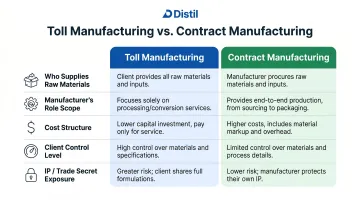
If you control your formula and sourcing relationships, toll manufacturing preserves that leverage. If you need someone to own the supply chain end-to-end, contract manufacturing does the heavier lifting — at the cost of visibility.
What is Toll Manufacturing?
Toll manufacturing is a business arrangement where the client company provides raw materials or semi-finished goods to a third-party manufacturer, who processes them to specification using their equipment, facilities, and labor — charging a pre-agreed flat "toll" fee.
The Society of Chemical Manufacturers and Affiliates (SOCMA) defines a "Toller" as a company that sells its manufacturing capabilities and charges a toll fee for equipment use. No chemistry development is involved — the customer provides a turnkey technical package and process support.
The toller operates within those provided process conditions. The customer retains full responsibility for chemistry performance and typically supplies raw materials, packaging, and material requirements planning.
Core Appeal
Toll manufacturing eliminates capital expenditure on equipment and facilities while giving the client full control over what enters the process. Since the client sources materials independently, the arrangement offers three practical advantages:
- Maintains purchasing leverage with existing suppliers
- Allows direct negotiation of supplier pricing without manufacturer involvement
- Enables supplier switches without renegotiating the manufacturing relationship
IP Risk Considerations
That control over materials comes with a trade-off: clients must share process know-how or formulation details for the toller to execute production correctly. This makes a well-structured tolling agreement with confidentiality clauses, non-compete provisions, and defined IP ownership essential before production begins.
Skadden, Arps, Slate, Meagher & Flom LLP outlines essential contractual safeguards including:
- Preliminary due diligence and facility audits
- Formal IP acknowledgements from the manufacturer
- Access control limited to specific, identified individuals
- Designated facilities for all transaction-related work
- Frequent audit rights extending throughout the manufacturer's enterprise
- Exit provisions requiring certified destruction of confidential information
Use Cases of Toll Manufacturing
Toll manufacturing works best when a client already controls the materials and formulation — but needs access to equipment or processing capacity they don't have in-house. It fits situations like:
- The client has established supplier relationships and proprietary material specifications
- Production requires specialized equipment the client doesn't own
- Volumes are variable or project-based
- The client wants to test a new formulation without committing to full in-house infrastructure
Industry Applications
Industries where toll manufacturing dominates include:
- Specialty chemicals such as resins, surfactants, and polymer additives
- Personal care formulations built around proprietary blends and specific processing conditions
- Flavours and fragrances including aroma molecules and essential oils
- Agrochemicals and industrial coatings where raw material quality directly determines product performance
According to SOCMA's 2026 Contract Manufacturing Outlook Report, nearly 70% of survey responses came from companies with annual revenues of $100 million (USD) or less, reflecting the prevalence of small and mid-sized firms leveraging toll processing to access specialized capabilities without capital investment.

What is Contract Manufacturing?
Contract manufacturing is a fully outsourced production arrangement where the manufacturer takes responsibility for the entire value chain — covering raw material sourcing, supplier management, production, quality control, and final delivery — all according to the client's specifications.
Core Appeal
Contract manufacturing lets brands bring products to market without owning any manufacturing infrastructure, managing suppliers, or building process expertise in-house. KPMG's June 2025 report identifies that speed-to-market has now surpassed cost optimization as the primary driver of FMCG outsourcing. D2C brands are outsourcing the entire production process, including formulation, to focus on brand building.
Key Operational Considerations
Because the contract manufacturer controls material sourcing, the client becomes dependent on the manufacturer's supplier decisions. The American Chemistry Council reported that raw material costs held roughly stable in Q4 2024, but energy, labour, and transportation costs continued rising — exposing clients to pricing shifts outside their control.
That dependency has direct implications for how clients must structure the relationship. Before production begins, brands typically need to address:
- Specification documentation — detailed technical briefs covering formulation, tolerances, and performance benchmarks
- Quality audit protocols — scheduled reviews to verify the manufacturer's processes meet brand standards
- Contractual protections — clauses covering IP ownership, batch rejection rights, and supplier substitution approvals
Use Cases of Contract Manufacturing
Contract manufacturing is the right fit when:
- The client is entering a new product category without existing supplier relationships
- Speed-to-market is the priority
- The client lacks in-house R&D or process engineering
- The production run is large enough that full outsourcing economics make sense
Industry Applications
Industries where contract manufacturing dominates:
- FMCG consumer goods — personal care and cosmetics brands
- Advanced polymer applications — wire and cable compounds, automotive masterbatches
- Industrial packaging — brands focused on marketing and distribution over production
Precedence Research estimates the plastic contract manufacturing market at USD 42.76 billion in 2025, projected to reach USD 75.46 billion by 2035 at a CAGR of 5.84%. The personal care segment tells a similar story: Grand View Research pegs the fragrances and deodorants contract manufacturing segment at USD 2,641.7 million in 2025.
Toll Manufacturing vs. Contract Manufacturing: Which Model is Right for You?
Frame your decision around five practical criteria:
1. Do you have existing supplier relationships and proprietary raw material specs? If yes, toll manufacturing preserves your leverage and quality control.
2. How sensitive is your formula or process IP? Toll manufacturing limits exposure since you provide the technical package. Contract manufacturing requires broader sharing.
3. How variable is your production volume? Toll manufacturing suits pilot runs and variable batches. Contract manufacturing works better for consistent, large-scale production.
4. What is your internal capacity for supply chain management? If limited, contract manufacturing's turnkey approach eliminates coordination complexity.
5. Are you optimizing for cost control or operational simplicity? Toll manufacturing offers cost predictability via flat processing fees. Contract manufacturing bundles costs into per-unit pricing.
Once you've worked through these criteria, the decision usually points clearly in one direction.
Situational Recommendations
Choose Toll Manufacturing if:
- You have reliable raw material suppliers
- You want to protect your formulation IP from the manufacturer
- You're running variable or pilot-scale batches
- You need cost predictability via a flat processing fee without ceding material control
Choose Contract Manufacturing if:
- You're launching a new product category without supplier infrastructure
- You want a single point of accountability from raw material to delivery
- You're scaling at pace and need full operational offloading
- You lack in-house R&D to manage formulation and supplier qualification
The Hybrid Middle Ground
Distil combines contract manufacturing's end-to-end scope with toll manufacturing's IP protections — offering a single point of contact from lab to commercial scale, while retaining client IP through process fragmentation and permission-based access controls. For brands that need both operational simplicity and formula security, this means you don't have to choose one at the expense of the other.
Real-World Scenarios: Applying the Right Model
Scenario 1: Toll Manufacturing for Cost Savings
A personal care brand with a proprietary surfactant blend partners with a toll manufacturer that owns the necessary reactor equipment. The brand ships its raw materials directly, the toller processes the batch to spec, and the brand retains full ownership of its formula and supplier relationships.
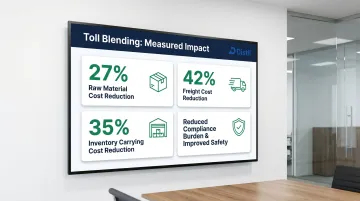
RBP Chemical Technology documented quantified results from a toll blending engagement:
- 27% reduction in raw material costs by leveraging the toller's supply chain
- 42% reduction in freight costs through optimized logistics networks
- 35% reduction in inventory carrying costs with on-site storage at the toller's facilities
- Elimination of Very Small Quantity Generator regulatory status, reducing compliance burden
- Improved employee safety by removing high-risk processing from the client's facility
Scenario 2: Contract Manufacturing for Speed-to-Market
An FMCG packaging company wants to launch a new polymer additive product but has no existing supplier base or formulation team. They engage a contract manufacturer who sources materials, runs application trials, and delivers the finished compound.
KPMG's research shows that FMCG outsourcing is now driven by agility and rapid market testing rather than just cost optimization. Global contract manufacturers are integrating packaging, proprietary formulation development, and ingredient innovation into turnkey services. For niche, high-growth contract manufacturers, KPMG reports valuation multiples of 13x to 17x trailing EBITDA, indicating strong investor confidence in the speed-to-market value proposition.
In this arrangement, IP agreements, quality audit clauses, and clear specification documentation become the critical safeguards.
For specialty chemical brands evaluating either model — particularly in personal care, advanced polymers, or flavours and fragrances — the choice of partner determines how quickly IP is protected, quality is locked in, and production scales. Distil's asset-light model addresses both scenarios: R&D-led formulation with built-in IP protection, managed from lab to commercial scale through a single point of contact. Explore how Distil can support your manufacturing needs.
Conclusion
The model you choose should reflect where your operational strengths lie and which risks you can't afford to carry. Brands with proprietary formulations or tightly controlled inputs tend to favour toll manufacturing; those prioritising speed-to-market and reduced operational overhead lean toward contract manufacturing.
Either way, a misaligned model carries real costs: IP exposure, batch inconsistency, or supply chain bottlenecks that compound as you scale. Pairing the right structure with a well-drafted manufacturing agreement is what separates a resilient production strategy from one that breaks under growth pressure.
Frequently Asked Questions
What is meant by toll manufacturing?
Toll manufacturing is when a company outsources production to a third party while continuing to supply its own raw materials. The manufacturer processes those materials to specification and charges a flat "toll" fee for equipment use and labor.
What is the difference between contract manufacturing and toll manufacturing?
In toll manufacturing, the client supplies raw materials and retains material control. In contract manufacturing, the manufacturer sources all materials and manages the full production process from sourcing through delivery.
What is the difference between turnkey and tolling manufacturing?
Turnkey (contract) manufacturing means the manufacturer handles everything from sourcing to delivery, requiring no input from the client beyond specifications. Tolling requires the client to supply materials and manage material sourcing and logistics on their end.
What is the purpose of a tolling agreement?
A tolling agreement is a formal contract that defines each party's responsibilities and protects IP through confidentiality and non-compete clauses. It also establishes quality standards, fee structures, and termination terms to safeguard both parties.
What does tolling mean in chemicals?
In the specialty chemicals industry, tolling refers to outsourcing a processing step — such as blending, reaction, or formulation — to a certified chemical manufacturer who uses the client's materials and charges a processing fee, without taking ownership of those materials.
What is toll manufacturing in the pharmaceutical industry?
In pharma, toll manufacturing refers to contracting a licensed, GMP-certified facility to process active pharmaceutical ingredients or formulations supplied by the client. FDA ICH Q7A guidance requires written agreements, audit rights, and strict change control protocols.