The challenge for formulators isn't just avoiding dimethicone — it's choosing the right functional replacement that maintains product performance. The wrong alternative can compromise sensory feel, barrier function, or shelf stability, undermining both brand reputation and consumer satisfaction.
TLDR
- Dimethicone delivers slip and barrier properties but raises concerns around biodegradability, pore congestion, and hair buildup
- Match alternatives to dimethicone's specific role — slip, barrier formation, or emolliency — rather than seeking a one-size-fits-all replacement
- Top natural alternatives include squalane, coco caprylate/caprate, hemisqualane, broccoli seed oil, abyssinian seed oil, and plant ceramides — among others covered in this guide
- Hair products perform best with dry-oil-profile ingredients like abyssinian or broccoli seed oil; skin care benefits more from humectants and ceramides
- At commercial scale, batch consistency for natural alternatives requires a specialty chemicals partner with dedicated R&D and quality oversight
What Is Dimethicone — and Why Are Formulators Moving Away from It?
Dimethicone (INCI: Dimethicone; CAS 9006-65-9), also known as polydimethylsiloxane (PDMS), is a silicone-based polymer that sits on the skin and hair surface. It forms a thin film that provides slip, reduces friction, seals in moisture, and gives products that characteristic silky, velvety feel without greasiness.
Three Functional Roles Dimethicone Plays
Dimethicone serves distinct purposes in formulations, and a natural replacement must target whichever role is primary:
- Non-volatile emollient: Provides long glide and slip in skin creams and hair conditioners
- Film-former: Reduces transepidermal water loss (TEWL) and seals the hair cuticle
- Texture modifier: Fills fine lines and gives primers their smooth, pore-blurring effect
Why Brands Are Reformulating
Silicones are not readily biodegradable. Two data points illustrate the scale of the problem:
- Research published in Environmental Science & Technology estimated approximately 13,600 metric tons of PDMS entered the environment in a worst-case assessment.
- The ECHA Committee for Risk Assessment found that D5 (decamethylcyclopentasiloxane) — a related volatile silicone — contributes 97.8–168.3 tonnes annually to EU surface water from wash-off cosmetics alone.
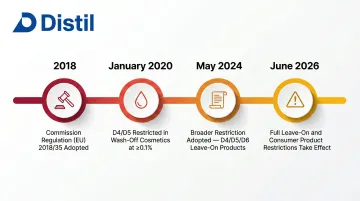
Commission Regulation (EU) 2018/35 restricted D4 and D5 in wash-off cosmetics at concentrations ≥0.1% by weight, effective January 31, 2020. A broader restriction adopted in May 2024 extends this to D4, D5, and D6 in leave-on cosmetics and other consumer products, effective June 6, 2026.
Consumer pressure is pushing in the same direction. Ingredients ending in "-cone" or "-siloxane" are increasingly flagged by label-reading consumers, making silicone-free positioning a meaningful commercial differentiator.
11 Natural Dimethicone Alternatives for Skin & Hair
These 11 alternatives are organized by functional role — whether they target skin, hair, or both, and what specific dimethicone function they replicate. Distil's personal care ingredient portfolio includes several bio-based and plant-derived alternatives for brands sourcing at commercial scale, including coco caprylate/caprate — a lightweight emollient with sensory performance that closely matches low-viscosity dimethicone.
Squalane
Squalane is a hydrogenated, stable form of squalene — typically sourced from sugarcane (via fermentation) or olive oil. It closely mimics the skin's own sebum composition, providing a non-greasy, fast-absorbing skin feel similar to dimethicone.
Dual skin and hair utility:
- Skin care: Lightweight moisturization without clogging pores (non-comedogenic rating 0-1)
- Hair care: Adds shine and reduces frizz without silicone buildup
- Usage rates: 0.5-2% in light serums; 2-6% in gel-creams; 6-12% in rich creams; 0.5-3% in hair leave-ins
Squalane is a fully saturated hydrocarbon, making it significantly more oxidatively stable than unsaturated plant oils. Biossance reports that sugarcane-derived squalane has 20 times fewer volatile impurities than olive-sourced squalane and offers greater supply consistency.
Coco Caprylate/Caprate
Coco caprylate/caprate is a coconut-derived ester (caprylic/capric acid + coconut fatty alcohol) that functions as a dry-touch, lightweight emollient with excellent spreadability. It is one of the closest sensory matches to low-viscosity dimethicone in skin care formulations including serums, sunscreens, and foundations.
- Palm-free and biodegradable: ECOCERT and COSMOS-approved for certified natural formulations
- Sensory performance: Industry sources note it often outperforms dimethicone in spreadability
- Function: Helps actives spread evenly across the skin surface, replicating dimethicone's slip without occlusion
Distil supplies coco caprylate/caprate at commercial scale with controlled impurity profiles and batch-to-batch consistency, produced through RSPO-certified feedstocks for brands requiring certified-natural compliance.
Hemisqualane (C13-15 Alkane)
Hemisqualane (INCI: C13-15 Alkane) is a bio-based, sugarcane-derived lightweight hydrocarbon that behaves like volatile silicones such as cyclomethicone. It spreads rapidly, dries quickly, and leaves a smooth, non-sticky finish with no residue.
Ideal replacement for:
- Cyclomethicone and low-viscosity dimethicone in hair serums
- Dry oils and leave-in treatments
- Primers and lightweight skin products
Hemisqualane is fully bio-based and readily biodegradable, with a straightforward INCI name — making it widely adopted in clean beauty formulations where silicone-free claims are a commercial requirement.
Broccoli Seed Oil
Broccoli seed oil (INCI: Brassica Oleracea Italica Seed Oil) is a plant oil with an unusually high erucic acid content (~50%) that gives it a dry, silky slip on both skin and hair — mimicking dimethicone's smooth glide while providing antioxidant and emollient benefits silicones cannot deliver.
Applications:
- Hair: Coats the cuticle without buildup, tames frizz, adds natural shine
- Skin: Non-comedogenic, absorbs cleanly
- One of the few natural oils that directly replicates dimethicone's "dry oil" tactile profile
Suitable for styling products, serums, and leave-in conditioners where lightweight slip is essential.
Abyssinian Seed Oil
Abyssinian oil (INCI: Crambe Abyssinica Seed Oil) is a high-erucic-acid oil (55-60%) derived from the crambe plant. It provides outstanding slip, light skin feel, and hair cuticle coating without the pore-clogging risk of heavier oils, making it functionally analogous to non-volatile silicone.
Research confirms erucic acid content of 52-65%, with MUFAs comprising 79-85% of total fatty acids. This high MUFA profile and long-chain erucic acid provide oxidative stability superior to high-PUFA oils and a silicone-like slip.
- Oxidative stability: Resists rancidity better than high-PUFA oils; suited to hair serums and skin primers
- Sensory: Passes sensory evaluations nearly on par with silicone
Bamboo Bioferment
Bamboo bioferment is a sustainable, fermentation-derived ingredient that provides slip, film-forming properties, and glossy shine in hair products. It functions as a direct replacement for conditioning silicones in shampoos, conditioners, and hair masks.
Active Concepts' ACB Bamboo Isoflavones PF increases epidermal slip by more than 60% versus control. It contains bio-chelated silica and isoflavones from fermented bamboo stalks and leaves.
- Usage level: 1.0-10.0%
- Benefits: Cuticle smoothing, static reduction, no occlusive barrier
- Biodegradable: Allows moisturizing actives to continue penetrating the hair fiber
Daikon Radish Seed Extract
Daikon radish seed extract (INCI: Raphanus Sativus Seed Extract) is a natural oil-like extract with good absorption, excellent slip, and emollient properties. It is positioned by suppliers as a direct natural replacement for both dimethicone (non-volatile) and cyclomethicone (volatile).
- Sourcing: Derived from a food crop (sustainable)
- Sensory: Clean profile with no greasy residue
- Applications: Skin serums, hair conditioners, color cosmetics where spreading and slip are critical
Plant Ceramides
Plant ceramides (typically derived from wheat, rice, or sunflower) are lipid molecules structurally similar to those naturally found in the skin and hair cuticle. They replace dimethicone's barrier and film-forming role rather than its slip or emollient role.
Best-fit applications:
- Skin care: Restore the stratum corneum lipid barrier, particularly valuable for sensitive, dry, or compromised skin
- Hair care: Restore cuticle integrity, reduce moisture loss, strengthen the fiber from within
Research by Oh et al. (2017) demonstrated that phytoceramides at 3.5% w/w significantly accelerated stratum corneum barrier recovery (measured by TEWL) compared to standard ceramide controls, with statistical significance reached at 12 hours post-application.
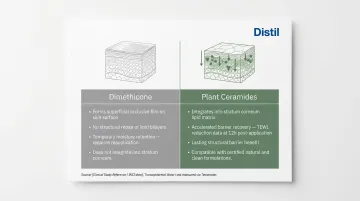
Plant ceramides provide lasting structural benefit that silicones only mimic superficially, and are suitable for certified natural formulations.
Glycerin
Glycerin (INCI: Glycerin) is a plant-derived humectant that pulls moisture from the environment into the skin, serving as a replacement for dimethicone's moisture-retention function specifically — rather than its slip or barrier properties.
Usage guidelines:
- Leave-on moisturizers: 2-5%
- Serums and toners: 5-8%
- Wash-off cleansers: up to 10%
At concentrations above ~5% in leave-on products, glycerin can feel tacky, so it is typically combined with emollients like squalane or coco caprylate for a balanced, dimethicone-like finish. Glycerin is one of the most well-researched cosmetic ingredients with a strong safety and efficacy profile.
Colloidal Oatmeal
Colloidal oatmeal (INCI: Avena Sativa Kernel Flour) is a finely milled oat-derived ingredient that acts as both a film-former and skin-soothing emollient. It is effective for replacing dimethicone's barrier and smoothing function in products targeting sensitive, eczema-prone, or reactive skin.
Research by Capone et al. (2020) demonstrated that 1% colloidal oat eczema cream significantly improved skin pH, barrier function, and skin hydration from baseline to day 14 in patients with mild-moderate atopic dermatitis (n=61). EASI score reduced by 51%; ADSI score reduced by 54%.
Colloidal oatmeal is FDA-approved as an OTC skin protectant under 21 CFR 347.10(f), giving it regulatory credibility that many natural alternatives lack. Approved minimum concentration: 0.007%.
Kaolin
Kaolin (INCI: Kaolin) is a naturally occurring soft clay mineral that replicates dimethicone's oil-control and matte-finish function in skin care — particularly in primers, foundations, and mattifying moisturizers — by physically absorbing excess sebum from the skin surface rather than forming a silicone barrier.
A study by Sarruf et al. (2025) demonstrated that kaolin-based formulations produced statistically significant reduction in skin oiliness at 2 hours post-application. Higher kaolin concentrations (21%) showed significantly greater sebum reduction versus placebo.
Usage rates:
- FDA OTC skin protectant monograph: 4-20%
- Cosmetic formulations: 3-21% depending on desired mattification
- Also used in: Dry shampoos as a natural alternative to silicone-based texture agents
Kaolin is gentle enough for sensitive skin and suitable for oily or combination skin types.
How to Choose the Right Dimethicone Alternative for Your Formulation
The right dimethicone alternative depends on the function you're replacing — not just the ingredient category. Identify what dimethicone is doing in your specific formulation before selecting a replacement.
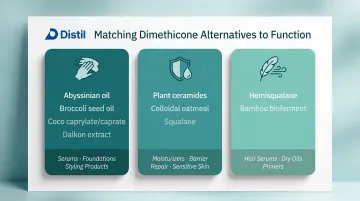
Three Functional Profiles
1. Slip and spreadability (serums, foundations, styling products): Abyssinian oil, broccoli seed oil, coco caprylate/caprate, daikon extract
2. Moisture barrier and film formation (moisturizers, barrier repair, sensitive skin): Plant ceramides, colloidal oatmeal, squalane
3. Lightweight volatile feel and quick dry-down (hair serums, dry oils, primers): Hemisqualane, bamboo bioferment
Application-Specific Considerations
Rinse-off hair products (shampoos, conditioners):
- Use biodegradable alternatives like bamboo bioferment and daikon extract that won't cause buildup
Leave-in hair treatments and serums:
- Oils with dry profiles (abyssinian, broccoli seed, hemisqualane) perform best
Skin care targeting hydration:
- Reach for humectants and ceramides rather than oils alone
Oil-control or mattifying skin products:
- Kaolin is the direct functional match
Formulation Stability and Compatibility
Unlike silicones, natural alternatives lack chemical inertness — so swapping them in isn't always plug-and-play. Expect adjustments to emulsifier systems, preservation strategy, and sensory profile. The INOLEX Silicone Alternatives Guide maps specific silicone attributes (volatility, fast spreading, decreased dry time, moisture retention) to bio-based replacements.
Before scaling production, validate performance with:
- Side-by-side sensory panels to assess texture, spreadability, and finish parity
- TEWL measurements to confirm barrier function — clinical studies confirm this is the standard validation method for dimethicone alternatives
- Stability testing across temperature and humidity ranges relevant to your target market
Conclusion
Replacing dimethicone successfully comes down to matching the right functional ingredient to each application. Whether that's a plant ester for slip, a ceramide for barrier repair, or a bio-based alkane for lightweight dry-down, the 11 alternatives covered provide formulators with a comprehensive toolkit for reformulation.
Brands reformulating with natural silicone alternatives need more than an ingredient list — they need batch-to-batch consistency at commercial scale. Distil's personal care team works directly with brands to source, trial, and scale natural alternatives to conventional silicones, with application-specific R&D support from development to commercial production.
Contact Distil to discuss sourcing, trialing, and scaling your reformulation.
Frequently Asked Questions
What is a substitute for dimethicone?
The best substitute depends on the application — for slip and emolliency, plant-derived esters like coco caprylate or abyssinian seed oil are closest in sensory feel; for moisture barrier function, squalane or plant ceramides are effective; and for volatile/lightweight applications, hemisqualane (C13-15 Alkane) is the most widely adopted replacement.
What is an alternative to dimethicone for skin?
For skin care formulations, squalane, glycerin, and colloidal oatmeal are among the most effective natural alternatives — each targeting a different dimethicone function (emolliency, humectancy, and barrier/smoothing, respectively). They can be combined in a single formula to replicate dimethicone's multifunctional profile.
What is a natural alternative to silicone for hair?
Plant-derived oils with a dry-oil profile — such as broccoli seed oil and abyssinian seed oil — closely replicate silicone's cuticle-coating, frizz-control, and shine-enhancing effects in hair products. Bamboo bioferment is effective in rinse-off conditioners and masks without the buildup concern associated with silicones.
What is a safe alternative to silicone?
Most plant-derived silicone alternatives — including squalane, coco caprylate, glycerin, and colloidal oatmeal — have strong safety profiles backed by cosmetic safety assessments. Colloidal oatmeal has FDA OTC monograph recognition. Safety should be assessed for both the end consumer and the environment — biodegradability is a key criterion when evaluating any silicone alternative.
What is a natural alternative to cyclomethicone?
The closest natural equivalents to cyclomethicone are hemisqualane (C13-15 Alkane, sugarcane-derived) and daikon radish seed extract. Both deliver rapid spreading, a dry finish, and quick evaporation, and are widely used in hair serums and skin primers.
What is another name for dimethicone?
Dimethicone is also known by its INCI name polydimethylsiloxane (PDMS) and may appear on labels as dimethyl polysiloxane. In pharmaceutical contexts, simethicone refers to a dimethicone-silica mixture used for gas relief. On ingredient labels, the "-cone" suffix is the easiest identifier.